So begins my Big Adventure of Arctic Winter Camping. George and his friend, Chris, pack up all our supplies for our night of winter camping. For 6 people, we need six sleeping bags, food, back packs with personal supplies, Arctic Tent (canvas and wood burning stove), extra gas for snow machines, and of course, toilet paper!!!Chris teaches history and has a vast knowledge of Alaska history and Yupik culture. He is also an Eagle Scout. His can tie so many different knots and his knowledge of winter survival is incredible.
Once again the tundra. This looks so different from Anchorage mountains! Beautiful in another Alaskan

way. A tundra has no trees because the temperatures are very low (below freezing most of the time) and a very short growing season and super windy. Bethel had 3 weeks (the first three weeks in January) were all 50 below zero plus wind chill. I guess I have to say, Bethel did not have school for three weeks waiting for the water pipes in the town and school to thaw. More about the water pipes later.
This really shows you the tussock terrain. Very large clumps of grass strewn everywhere. They are so hard to walk on and twisting ankles is common. When the snow is gone this is a swamp area and George told us to get around the tussock is to jump from one to the other. I told someone it was like skiing downhill with a lot of moguls. The moguls are the tussocks. The animals that live in on the tundra are the Arctic Fox, Arctic Hare, Caribou, Lemmings, and Musk Ox.
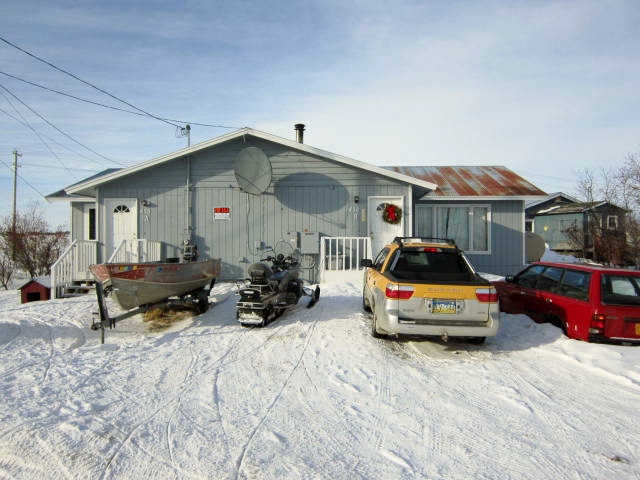
On our snow machines leaving for the Bluffs (about 35 mins out of Bethel) we saw this house. This is what you do with empty 55 gallon drums - line your drive and then plant flowers on them.
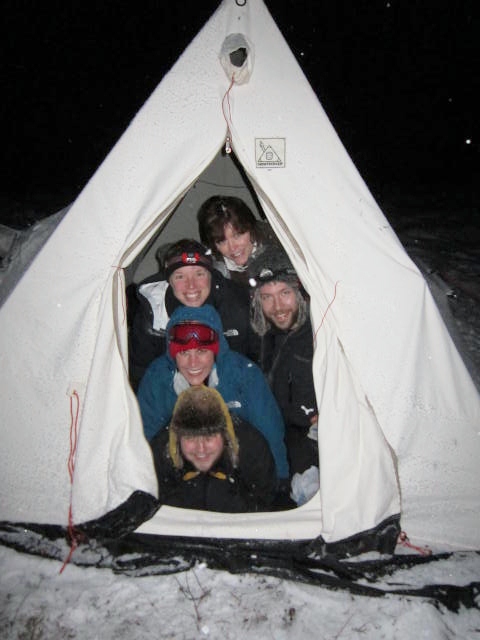
My tent mates for the weekend. Sarah, George, Beth, Niki and Chris! What an awesome team.
Putting up the Arctic Oven Tent. It is a canvas tent with NO FLOOR and a small wood burning stove.
The no floor was quite the surprise for me. Yep, we slept right on the ice and snow. See the black part of the canvas - about 6 inches. This part of the tent lies on the snow and then we place as much snow as possible on the black canvas. Why you ask? I did! The snow acts as a buffer and keeps the wind out of the tent.
Chris tried to make a leintwo out of the plastic trailer. Can you tell he is an official Eagle Scout.
This is the Arctic Oven up and going. Brad, another friend, stopped by to say "hi" and helped us settle camp. He found these wonderful twigs to support the stove vent outside the tent. This canvas tent has wonderful supports on three sides. You can see the steel bar that runs through a pocket and has tether straps to place in the ground. These supports pull the sides of the tent away from the living space. That is our hack saw and gun case outside the tent for us to use. Notice you can't see any black canvas!
It may not look like awe are very high up but in the tundra we are on one of the highest points - the Bluffs. The willow bushes are the dark looking things in the distance. Then you can see the frozen Kuskokwam River in the background. We are about 100 feet above the Kuskokwam River.
Looking in the tent you can see our supplies, sleeping bags, food box, toilet paper and guns. If you look closely you will see snow pressed up against the sides of the tent.
The infamous Arctic Oven - aka small wood burning stove. My job was to put it together. It comes in a handy dandy box. Niki and I had it up and ready in about 15 minutes. I couldn't start the fire but I got things ready. Why couldn't I start the fire Because I didn't have a match and fire starters. These Alaskan boys are so resourceful. You know how they make fire starters? Empty egg cartons, fill each egg holder about 3/4 full of dryer lint, then drip wax over the lint. PRESTO! you have 12 very nice and effective fire starters for very little money. If you go in the wilderness make yourself some and you will be surprised how easy they start a fire.
After camp was set up the Boys had to be Boys and play!! Below are George, Brad, and Chris. Brad is another teacher in Bethel. He teaches a Kindergarten and 1st grade mixed class. He has taken Yupik speaking classes so he can talk to his students and families easier.
This is Bethel Highway. Yep, the frozen Kuskokwam River is the only highway into Bethel for many of the villages. The State Department even plows it for easier travel. Snow machines and trucks drove on this highway all night and all day. There are many people who have fish traps on the River. They have these poles - maybe 5 in a row. They drop a net between and then reach under the freezing water to string the nets under the water. They are fishing White Fish.
For all of you who have heard me talk about my Bunny Boots, here is what they look like in action. They keep my feet so warm. My little brother, Chip, is coming for a visit next week and he will be wearing a pair and he will tell you how warm they are. The black bunny boots are good for temps to minus 25 degrees. The white Bunny Boots are good for temps to minus 60 degrees.
Friends sharing another wonderful Alaskan Adventure!
Here is the Girls bathroom at our camp site. The small twig held the roll of toilet paper. It got a bit damp but it worked!
This is the refrigerator for the camp site.
Now it is time for challenges to begin. Girls with Guns is what we called ourselves. This is Beth getting the sight on the target.
I thought I would give it a try. The sight was helpful but the target was
60 feet away.
Can you see the three targets on the tundra? The orange one is easiest to see. I almost hit it! But can you see the other two targets? Look closely. They are empty silver cans and about 75 yards away. Did you know Alaskan Natives can see about 30 shades of white while you and I can see only 5 shades of white. I promise I only see one shade of white when shooting!!!
Beth is showing her sexy poster pose on the snow machine!
When we all took a few minutes from playing around and shooting, we decided to take the snow machines to a small village. We hoped on the snow machines and drove about 20 minutes to the village of Oscarville. This is a village of 120 people with about 85 students.
I am going to show you this village not to get you to feel sorry for these villagers, but to remind us how different people live in the United States. I know some of you forget that Alaska is part of the United States and you can find tiny towns like this all over the lower 48. The difference is this village of Oscarville is located in a very cold and mostly below zero weather conditions. Oscarville is 1 square mile and has one school (k- 12 grade). The boys all knew the four teachers who taught in Oscarville so they went inside and visited while some of us looked around the village. They are such humble people so much so that when they saw us, strangers, they quit what they were doing and stood inside their house. I normally ask if I can take pictures but since I don't speak Yupik and they did not stay near enough for me to ask i took just a few pictures.
This is the school in Oscarville. It houses all 85 students. There are at least 30 pairs of cross country skis on the school entrance. Next to the stairs is a number chart in feet so the students can record the snow fall or water for the years.
The above picture is a sweat house. The little boy was chopping wood until he saw strangers and went inside. I asked one of the local teacher to let us peek inside. The front part is tall so you can walk in and undress. The back part is much shorter to keep the heat in.
Below is a creative dog house. It is an old refrigerator with the motor area cut out so the dog can enter the dog house. I am sure it will be warm inside.
Then we went and saw the water storage area for the school. There is no city water in Oscarville. So the water is stored and then used sparingly. George told us about the formula they use to determine how much water they can use per day. They receive water every month by snow machines or boat.
This is the insulation surrounding the water pipe to keep it from freezing.
This is teacher housing provided by the school district. The couple living there were celebrating the new windows. They finally have a double insulated windows (you can see the tags on some of the windows).
This is where the young boy was chopping wood and moved when he saw us.
This is a local family who has their laundry out to wash? Dry? or Both? Did I mention that the temperature was ZERO and with windchill it was Sub Zero numbers.
Back to camp before it gets too dark. We have lots of stories to tell and laugh at. Let's roll back to camp.
It was such a gorgeous day. The weather was about zero all day and then it started to snow. Not little snow flakes. Look at the size of those flakes!
Isn't this a great picture This is tent mates rejoicing over a wonderfully warm environment.
We got in the tent to play some cards. When the stove was burning wood full blast, it was like sweat lodge inside the tent. But when the wood was burning low it did get chilly. Chris slept nearest the fire so he could keep it going. The rest of us, 5, slept with our sleeping bags from the left to right. It was very close quarters that made turning to your side more like spooning with your tent mate. I was nestled between Niki and Beth. I was warm but squished. Beth and I had one tussock near our hips. Poor Niki has several tussocks to sleep on. We tried to pack more snow around the tussock to make it smoother but that didn't work too well.
Good morning. We survived. At one point there were wind gusts up to 30 mph (according to the GPS)
Packing up from a great adventure. Doesn't it look like we are hauling a mummy?
This is the ground after a night of sleeping and an Arctic Oven working. I am sure some of the wildlife will be around soon to scavenge for some cranberries and lichens.

Back at George's house he asked us to return something to Anchorage. Bethel is a wet village (you can bring in Beer but only one bottle of wine or hard alcohol) so George and the other teachers hosted a Super Bowl party and had some beer shipped into Bethel. Have you even seen a keg labeled "Alcoholic beverage"? Why was it labeled? Because the shipments that come into the village are being delivered for everyone. Some restaurant might have ordered Coca Cola and this way they can tell which keg goes where. Another thing about the village of Bethel. George can call a grocery store or alcohol store in Anchorage, pay by credit card and the store will make sure the order gets to the air port so it can be flown to the village. I can't have wine sent from California to Memphis! Alaska Airline allows three FREE checked bags when traveling in the state. So we volunteered to claim the empty keg as one of our checked bags. BTW, it cost $100 for shipping costs to get this keg to Bethel. That is only the shipping costs which does not include the beer costs.

To celebrate a fabulous weekend of winter camping we celebrated with a new liquid luge George built. He saw one in the summer in the lower 48 and built his own. I would rather drink from a glass!
I hope you enjoyed my Arctic Oven Winter Camping adventure. It was an experience very few people will be able to experienced. I have less than three months left in my great adventure and I am taking in all that I can. We will be traveling to Nome to work the end of the Iditarod race and will show you another village of Alaska then.
Until next blog. Remember to enjoy every day and opportunity you are provided. All these experiences color your world and give you a positive approach to life!
Enjoy. Nanuq of the North,
Sheryl